From Awareness to Action: How Men Can Help Build Truly Inclusive Workplaces
International Women’s Day often brings a welcome spotlight to the experiences, achievements, and challenges of women at work. But what makes the difference between a moment and a movement is what happens around it – the intent, the design and the actions that follow.
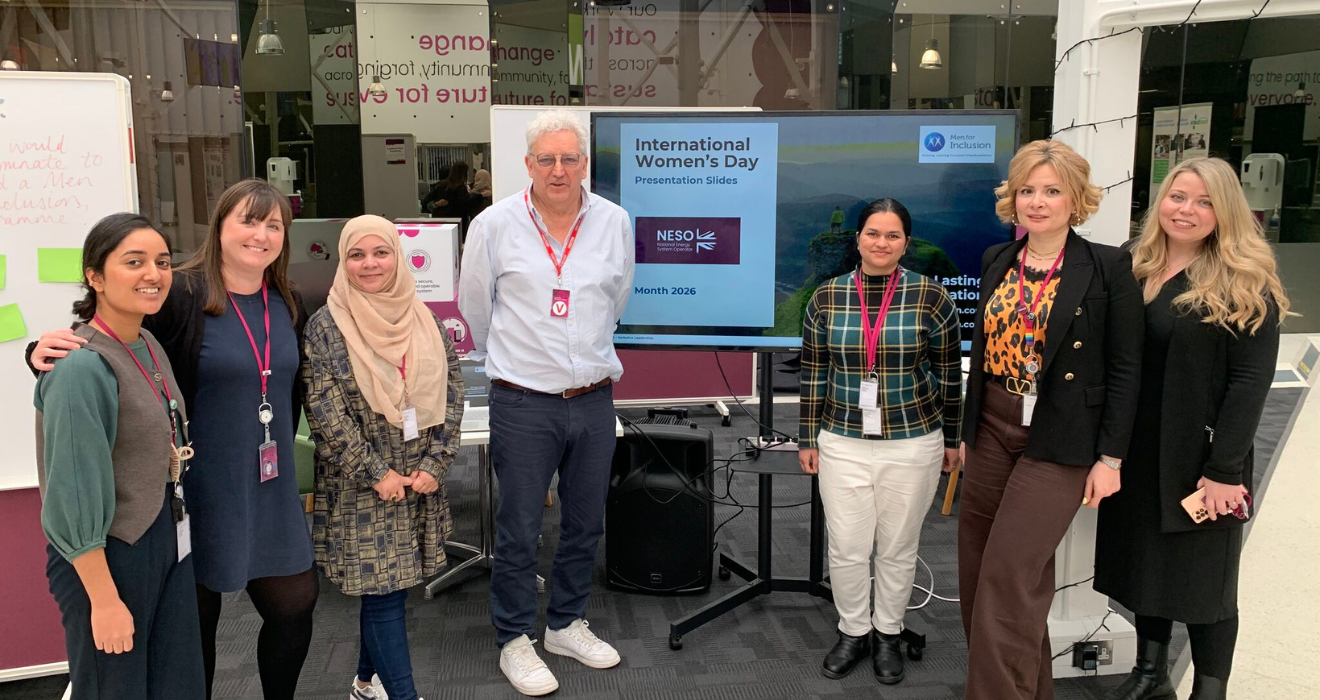
Recently, National Energy System Operator (NESO) demonstrated what meaningful inclusion can look like in practice. Through a thoughtfully curated programme, they created space not only to celebrate women, but to actively strengthen a culture where inclusion becomes the norm — not the exception.
Designing inclusion with intent
What stood out most was the balance.
Events created spaces for connection and belonging among those who are often under-represented, while also opening visibility across the wider organisation. This dual approach matters. Inclusion isn’t just about safe spaces; it’s also about shared understanding.
As Iffat Zahra Rizvi reflected, the experience aligned deeply with NESO’s values showing that inclusion isn’t a side initiative, but something embedded into how the organisation shows up.
And it’s worth pausing on the quote she shared from Sheryl Sandberg: “In the future, there will be no female leaders. There will just be leaders.”
That future doesn’t arrive on its own. It’s built through intentional actions like these.
The role of men: From supporters to participants
A key part of NESO’s programme was the inclusion of a Men for Inclusion workshop not as an add-on, but as a vital component.
Too often, inclusion efforts are seen as something “for” under-represented groups, rather than something everyone is responsible for shaping. But culture doesn’t shift unless those in the majority actively engage.
As Mark Freed highlighted, these conversations are essential in “nudging cultures and behaviours in the right direction.” They create opportunities to reflect, challenge assumptions, and build the awareness needed to act differently.
For men, this is where the work becomes real.
What inclusive leadership looks like in practice
Inclusive leadership isn’t about having all the answers, it’s about creating the conditions where others can thrive. At NESO, that showed up in:
Intentional programming that balanced celebration with learning
Visible leadership support, reinforcing that inclusion matters at every level
Spaces for honest conversation, where people could connect and feel heard
Partnerships, like Men for Inclusion, that bring fresh perspectives and challenge the status quo
Leaders such as Dr. Roya Ahmadi, Jo Greenan and Shweta Mahesh Kamat played a crucial role in setting the tone, showing that inclusion is not just endorsed, but actively led.
Moving beyond the moment
International Women’s Day can’t be the only time we talk about inclusion. The real impact lies in what continues afterwards.
For men looking to play a meaningful role, the question isn’t “What do I say?” it’s “What do I do next?”
Do you create space for others’ voices in meetings?
Do you challenge behaviours that exclude, even subtly?
Do you stay engaged in conversations that may feel uncomfortable?
Inclusion is built in these everyday moments.
A shared responsibility
The example set by NESO is a reminder that inclusive cultures don’t happen by accident. They are shaped by people, by leaders who prioritise them and by individuals who choose to engage.
For men, being part of this isn’t about stepping back it’s about stepping in, with intention.
Because the goal isn’t just to celebrate inclusion.
It’s to make it standard.