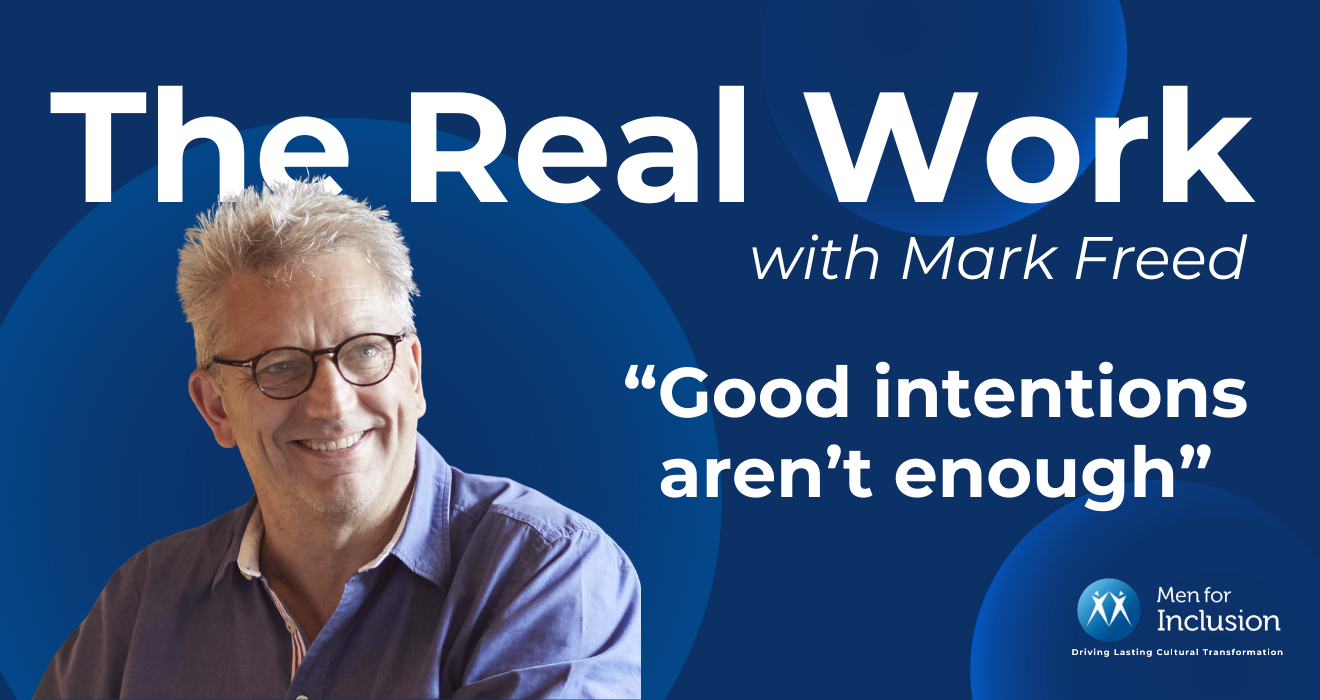
The Real Work: Good Intentions Aren’t Enough With Inclusion
The Real Work, with Mark Freed – a series about what inclusion should mean today. Today’s post focuses on allyship and whether it’s enough in today’s environment to reach true systemic equality.
In the past decade, allyship has become one of the most popular and visible expressions of commitment to diversity, equity and inclusion (DEI). And rightly so. When done well, allyship matters. It signals awareness, empathy and a willingness to stand beside those who experience disadvantages.
But if organisations are serious about sustainable inclusion, we must ask the question: is allyship enough?
Increasingly, the answer is no.
The organisations making real progress are not those with the most vocal allies. They are those developing inclusive leaders: people who move beyond supportive behaviours and take accountability for building systems where everyone can thrive.
Allyship: valuable but often episodic
Allyship typically shows up in moments. An ally might:
- speak up when they witness bias
- sponsor an individual
- challenge inappropriate behaviour
- show public support for underrepresented groups
These actions are important. They create psychological safety and signal cultural intent.
But allyship is often situational and discretionary. It depends on individual courage in specific moments. It can be powerful, but it is rarely sufficient to shift organisational outcomes at scale.
Put simply: Allyship helps people navigate the system. Inclusive leadership improves the system itself.
Where real change happens
Inclusive leaders operate differently. Rather than relying on moments of advocacy, they embed inclusion into the everyday mechanics of leadership, taking a look at:
- who gets stretch opportunities
- whose voice is heard in meetings
- how performance is evaluated
- how talent pipelines are built
- how psychological safety is maintained
Most importantly, inclusive leaders recognise that inclusion is not a side activity, but a core leadership capability tied directly to performance, innovation and retention. They don’t just support fairness. They design for belonging.
This is how organisations create environments where people feel truly seen, heard and valued.
The question of power
One of the biggest differences between allies and inclusive leaders is accountability linked to power. Allies may or may not hold positional authority. Their support, while valuable, is often voluntary.
Inclusive leaders, however, use their formal and informal power deliberately. They understand that culture shifts fastest when those who allocate resources, shape teams, influence promotion and control opportunities take ownership of inclusion outcomes.
This is particularly relevant when engaging men in the inclusion conversation. Many men want to help. Many are willing allies. But progress accelerates when they see inclusion not as an act of support, but as a leadership responsibility.
From performative to embedded
Another uncomfortable truth: allyship can sometimes drift into performative territory. Badges are worn. Statements are made. Panels are joined.
But inclusive leadership is much harder to perform because it shows up in measurable outcomes, such as who gets promoted, who stays, who speaks, who leads and who feels they belong. Inclusive leaders move the conversation from intent to impact.
It’s important to not position allies and inclusive leaders as opposing groups, but rather see them as stages of growth:
- Awareness – understands inequity exists
- Ally – speaks up and offers support
- Advocate – uses influence intentionally
- Inclusive leader – redesigns systems and culture
Allyship is often the gateway. But it should not be the destination.
The leadership imperative
If we want workplaces where everyone feels seen, heard and valued, we must raise the bar.
We must expect leaders to own inclusion outcomes. To equip them with the skills to lead inclusively and measure what actually changes. To move beyond celebrating good intentions.
Because, in the end, good allies make a difference. Inclusive leaders make it stick.
The organisations that understand this distinction will be the ones that turn aspiration into lasting cultural change.
To hear more from Mark, follow him on LinkedIn here.
Read more
Why DEI Progress Requires Systemic Change
Why Progress Accelerates When Men Join the Conversation
How 8 – 12 Hours of Training Can Turn Any Manager Into an Inclusive Leader